Sunday, 23 March 2014

Friday 21st March 2014


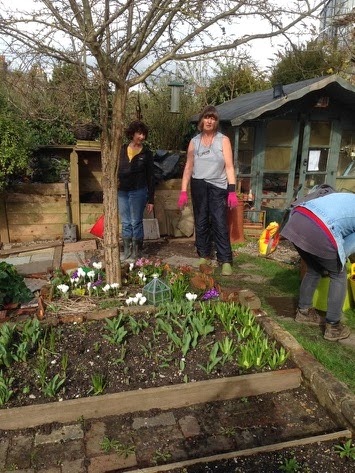
We had some discussion about veg growing before venturing out into the garden. One suggestion for protecting seeds until they are established is to cover the seed drill  with a piece of guttering after sowing - this can help protect the seeds from cats, mice, birds etc. It is often difficult to grow carrots and parsnips on chalky soils so it is important to ensure the ground has been well raked over to a fine tilth before sowing , or grow shorter stumpier varieties of carrots/ parsnips. Another suggestion is to make a hole in the soil with a dibber and fill the hole with good quality compost and sow the seed into that. Suggested companion planting for carrots are coriander or onions as the strong smell of these plants helps protect against carrot fly. Carrot seeds could be mixed together with onion seeds and both sown together ( Ms Raven suggests using North Holland Blood Red onion seeds for this). Another suggestion from her is to plant broad beans in the valleys between the earthed up potatoes. Now is a good time to start beetroot off in modules and then transplant once the soil is warm enough and the plants are established.Calcified seaweed is good to add to vegetable beds and do consider crop rotation especially in allotments as this can avoid the build up off disease and improve yield.

Plant identification:

  • Chionadoxa - which means Glory of the snow in Greek They are easy to grow in well drained soil in grass or under shrubs. They also make a small focal point around the base of a tree and flower in Feb/March

Chionadoxa


  • Muscari or grape hyacinth. We looked at a special variety called Muscari macrocarpum 'Golden Fragrance' which is larger and has a lovely gardenia like scent, buds emerge as dusky purple turning to yellow
    Muscari macrocarpum 'Golden Fragrance'

  • Anenome blanda - which is a delicate blue anenome and can thrive in partial shade to full sun
    Anenome blanda

Activities in the garden this week:
  • Creating beds for veg, erecting a runner bean frame and planting carrots and beetroot
  • Tidying the yellow bed by the shed
  • Continuing the work on the path
  • Working underneath the arches to sort and clear
  • Working on the herb bed to cut back and plant

Saturday, 15 March 2014

Friday 14th March 2014

A great effort from the Friday gardening group working to transform Ally's daughter Sam's garden. Everyone worked really hard to clear and dig over beds and cut back shrubs and trees. Karin and Elaine deserve special mention for their fantastic effort taking 2 huge sacks of cuttings to the tip!


Saturday, 8 March 2014

Friday 7th March 2014


Barnsley House gardens - home of Rosemary Verey
Julia read from Rosemary Verey's gardening diary about jobs to do in the garden in March. So many things to be getting on with now that spring seems to have arrived. The Garden House garden will be open on April 13th for the National Garden Scheme so lots of work to do in readiness for that.

We had a quick plant identification:
Primula veris

Narcissus Minnow

  • Saxifrage - great as an edging plant or to grow in an alpine collection. They need a well drained spot.
  • Narcissus 'Minnow' - a dwarf narcissi with lovely  scent and has a number of flowers on each stem
  • Leucojum vernum - spring snowflake, related to snowdrops and can be used in a rock garden, added to a moist border or naturalised in grass
  • Primula veris - cowslip - a semi evergreen perennial  favours a sheltered position in sun or semi shade. Good for edge of a woodland area.

Activities in the garden this week:

  • Pruning and feeding hybrid tea roses 
  • Planting aconitums and knifofia 
  • moving the cold frames to outside the greenhouse
  • establishing a fernery in top garden
  • sowing peas and herbs/ salad in guttering in greenhouse
  • potting on rosemary cuttings
  • continuing work on the path


Sue and Vicky continue with their path work
    Julia and Karin planting mint collection in the tanks
    Aniseed at the Friday group

Saturday, 1 March 2014

Friday 28th February


An unexpectedly dry and warm Friday morning so we spent as much time as possible getting on with jobs in the garden.
Nanette completes her bottle edging


We did have some discussion about feeding plants as we had some lovely compost delivered to the garden. There has been so much rain recently that it is good to try and enrich the soil and provide more nutrients to the soil to help the plants with their spring growth.
There are three main plant foods - nitrogen, phosphorus and potash and any fertilizer will primarily provide these in various proportions. Bridge suggests keeping it simple -  it is good to focus on adding manure and compost to the soil to bulk it up,enable the soil to hold moisture as well as adding essential nutrients.
Nitrogen is the most essential plant nutrient and is responsible for green growth and is created almost entirely by decaying organic matter and is provided by adding compost or manure.
Phosphorus supplies phosphates to the plants which they need to develop strong roots and to promote germination.
Potassium in the form of potash is essential for all plants but particularly for fruiting crops. Potash is released from compost and wood ash, comfrey and seaweed are good sources of potassium.
Seaweed can be bought as a liquid feed and is good for feeding plants in pots. Chicken pellets provide essential nutrients and should be added to the soil when planting.

 Activities in the garden this week:

  • setting mosaic tile in the lawn
  • pruning the cox's apple tree in the corner of the garden behind the shed
  • planting a new mint collection in the tanks 
  • feeding auriculas with liquid seaweed
  • potting on hardy annuals and feeding them
  • working in top garden - adding compost and planting
  • making obelisk for broad beans to grow up
  • continuing the path work by compost bins
  • pruning the honeysuckles
  • hoeing the borders
  • painting the bench
  • planting hellebores and pulmonarias

Ruth on apple tree pruning
Susan hoeing the large border


Ally watering in


Tuesday, 18 February 2014

Friday 14th February 2014

On a very wet and windy Valentine's morning 7 of us braved the weather to visit Chelsea Physic Garden to see the snowdrops.


The Garden was founded in 1673 by the Society of Apothecaries of London so their apprentices could learn to grow medicinal plants and study their uses.The 4 acre site next to the Thames was ideal,offering easy access to the river at a time when river travel was far easier and quicker than travel by road.This enabled the Apothecaries to go on their celebrated 'herborising' expeditions to collect plants.The site also offered free draining soil and a southerly aspect and the special micro-climate was perfect for many tender species including the largest olive tree grown outdoors in Britain.


The future of the garden was secured in 1712 when Dr Hans Sloane took over the freehold of the garden. He was sympathetic to the Apothecaries(he had studied in the garden in his youth),who were struggling with its upkeep.He granted them a lease on the garden of £5 a year in perpetuity on the condition that it was maintained as a physic garden.Today the garden is still dedicated to promoting education,conservation and scientific research and offers many workshops and courses.


Despite the appalling weather ,the garden was stunning with beautiful pots full of cheering spring bulbs and a marquee of common and rare snowdrops for sale..ranging in price from £3.50 to £60! Peter's mini tour was informative and gave us lots of insight into the garden's history and development.The Daphne and sweet box were beautiful-their scent filling the (very damp!) air.


We had a great lunch in the very inviting cafe and another walk round the snowdrop trail and beds specialising in dyeing plants and medicinal plants before a trip to the shop,coffee and cake and the bus back to Victoria.The train journey back was fun,we were all in good spirits after our visit and lunchtime glass of wine! I,for one will definitely be going back in the springtime..the garden is magical with wonderful trees and structure..I want to see it in the sunshine though! (written by Mandy Murray)


)


Saturday, 8 February 2014

Friday 7th February 2014

We discussed plans for the future charity day at the Garden House on 13th July and also the Garden Gadabout weekends in June.

Plant identification:

  • Helleborus orientalis, hellebores have pretty nodding cup shaped  flowers. They are excellent in woodland or in shaded areas and are good for under planting. They can be planted in raised beds so that the flowers can be seen more clearly. They grow well in chalk. They require little care apart from cutting back old leaves, they do self seed and can be divided when the plants are mature.


  • Hamamelis (witch hazel) is a group of five or six species of deciduous shrubs grown for their spider-like, fragrant, frost-resistant winter flowers and autumn leaf colour. They require moderately fertile but well drained soil in full sun or partial shade. They don't like chalk so could be grown in pots. Pruning requirements are minimal, they just  need  any crossing shoots removing in late winter/early spring to maintain a healthy framework. Hamamelis x intermedia 'Pallida' is a large deciduous shrub or tree with fruitily scented yellow flowers. Nymans is a good place to go to see witch hazels.


Hamamelis x intermedia 'Pallida'
Hamamelis x intermedia 'Diane'

  • Salix acutifolia 'Blue Streak' is a large deciduous shrub with a bluish - white bloom on the stems and narrow, dark green leaves. Slender silvery catkins to 5cm in length. It can grow to 5m and enjoys damp or wet soils in full sun or dappled shade. It is often pollarded and can be propagated by hard wood cuttings in winter.
  • Arum italicum 'Marmoratum' - a tuberous perennial with arrow shaped mid green veined leaves, long lasting from winter to late spring. It has spikes of red or orange berries and is best in semi shade. The leaves are often used in flower arranging.
Activities in the garden this week:
  • putting slates in the alpine sinks to divide up the planting areas
  • gritting up the pots containing the witch hazels
  • sorting out area behind the shed where all the stakes and poles are kept
  • starting work on building the structure for a stick house using hazel poles in the top garden
  • apple tree pruning
  • clearing beds and planting hellebores and pulmonaria

Pulmonaria

Sunday, 2 February 2014

31st January 2014

' The absence of summer clothing reveals the bones of the garden, in a new and reduced aesthetic. What we are left with at the beginning of the year is a newly revealed garden with space and air. Winter forms bear no resemblance to the voluminous greenery that they sported in summer.Some perennials bestow on the winter garden a skeletal legacy that is every bit as interesting as their summer incarnation.' (Dan Pearson, The Garden)
Winter time is also good for catching up on some garden book reading and planning ahead.
Contorted Hazel

We looked at a range of winter twigs:
  • Corylus avellana 'Contorta', contorted hazel or Harry Lauder's walking stick is slow growing and prefers sunny or semi shaded sites.
  • Hazel (Corylus avellana ) is a deciduous tree growing to around 10m but they are often coppiced. They flower from January to April. Hazel is monoecious: both male and female flowers are found on the same tree. Male flowers appear before the leaves and are long (2–8cm) pendulous catkins, yellow, hanging in clusters. Female flowers are small and bud-like with red styles 5mm. Hazel poles are good for fencing.
  • Ash (Fraxinus excelsior) can be identified by opposite black buds. Ash is dioecious, meaning that male and female flowers typically grow on different trees. 
  • Blackthorn (Prunus spinosa) is a small deciduous tree native to UK and has sloe fruits. It flowers before the Hawthorn as it flowers on bare wood.
  • Hawthorn (Crataegus) gets leaves first and then flowers (may blossom) - good for hedging and for wildlife.
  • Cherry (Prunus avium), prunus is a huge genus of  trees and shrubs that include plums, nectarines, peaches, apricots, almonds and can be deciduous or evergreen. They often have lovely bark.
  • Larch (Larix) -  is a deciduous conifer - it is very unusual to have deciduous conifers. 
Recommended books:

Roy Lancaster - Trees

Jake Hobson- Creative Pruning 


Barcham Nursery are recommended tree suppliers


Activities in the garden this week

  • starting a chilli plant trial-3 different seeds to be sown in pots and put into the propagator
  • sorting out the auriculas and gritting the pots
  • weeding beds and cutting back dead growth
  • pruning the blueberry and the pear tree
  • potting up succulents and cacti in strawberry planters


The hen appreciated the newly dug beds!