Saturday, 25 January 2014

Friday 24th January 2014


The weather was unexpectedly dry so our morning of reading gardening books and magazines had to be postponed. We had some discussion about taking cuttings and good ground cover plants. Generally cuttings should be taken just beneath the leaf node. There are some plants like clematis or honeysuckle where internodal cuttings can be taken. 

Plant identification

  • Anthemis punctata 'subsp cupaniana' ( Sicilian chamomile) - this is an evergreen perennial with silver green foliage. It is covered in long lasting white daisy flowers. It forms a loose mat and is good for growing in borders over slopes or in gravel gardens
    Anthemis punctata


  • Lamium maculatum 'White Nancy' -A short perennial that thrives in shade and makes good ground cover. The leaves are silvery-whitish, so they stand  out as do the pure white summer flowers. If it spreads too far, it is easily restrained by slicing back with a spade. Best grown in moist but well drained soil.
    Lamium maculatum 'White Nancy'
  • Lewisia cotyledon - a rosette forming evergreen perennial with fleshy leaves and salmon coloured flowers. It needs to be grown in well drained acidic soil - good for alpine beds or in crevices of a wall or in a pot. It is important not to let the rosettes get too wet.


Lewisia cotyledon
Activities in the garden this week:

  • seed sorting ready for Seedy Sunday
  • digging up,dividing and putting back some of the asters
  • pricking out the ammi seedlings
  • pruning the Judas tree in front garden
  • cutting the strawberry runners and potting up the new plants
  • pruning the blueberries in pots
  • cutting back the old leaves of the hellebores and feeding with chicken pellets
  • weeding and sorting out the plants by the pond
  • planting a new bare root climbing rose for Meg


Sunday, 19 January 2014

Friday 17th January 2014

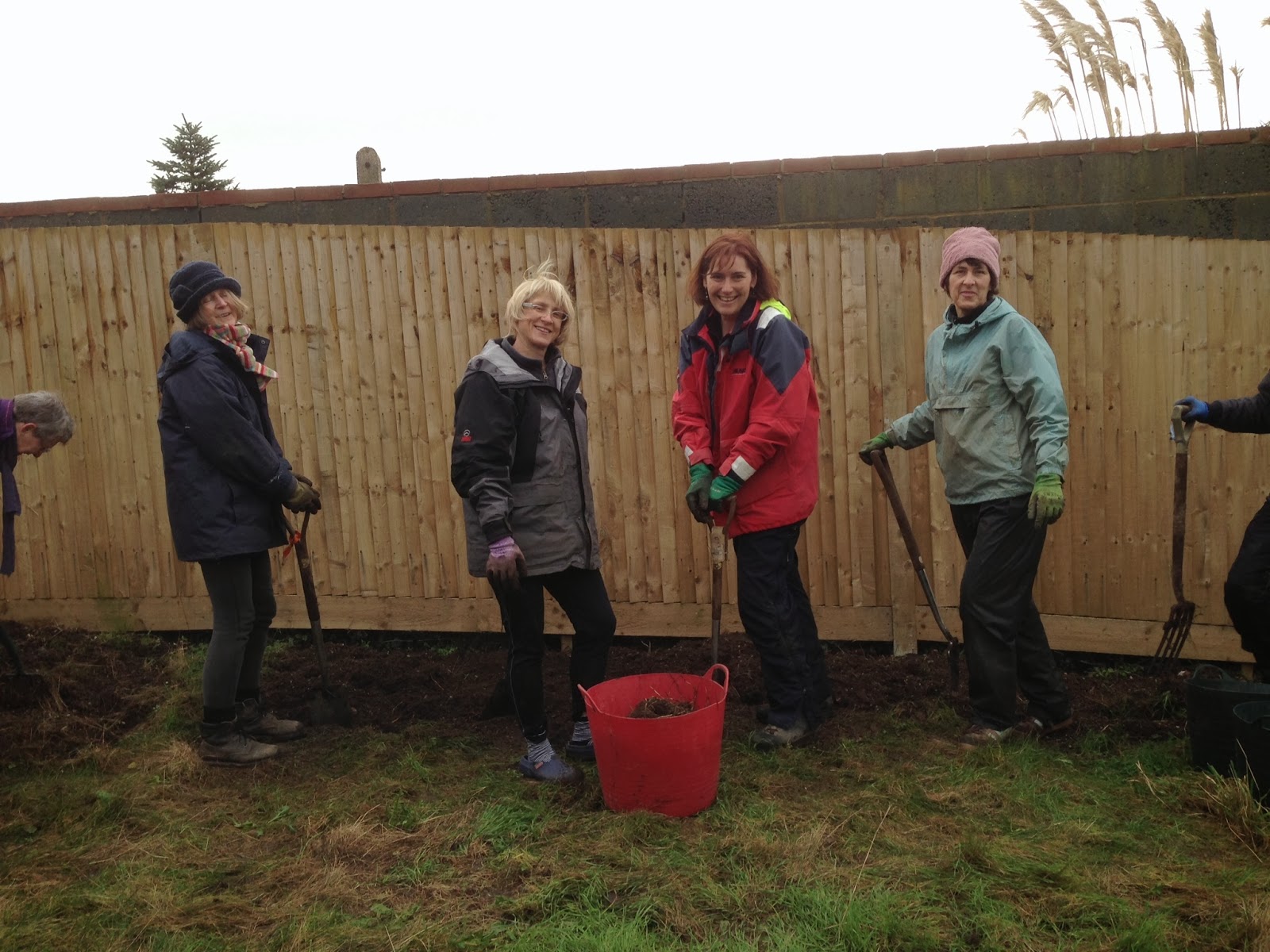
The Friday group decamped this week to work on Ruth's lovely garden in Woodingdean.
The group got stuck in to a number of gardening tasks to assist Ruth with the development of her garden - it certainly helps to have so many people working together!

Gardening activities included:
  • Digging over part of the top garden to create vegetable beds
  • Constructing frames for raised beds
  • Constructing compost bins
  • Pruning the apple tree
  • Planting another apple tree
  • Late planting of tulip bulbs
  • Sowing sweet pea seeds, nigella seeds and broad beans
The photos tell the story:


Sunday, 12 January 2014

Friday 10th January 2014

First group of the new year - lovely to see everyone and to get going again with our Friday gardening activities. The garden had survived the bad weather quite well and the sun even came out for us. We discussed winter flowering plants as these can often be very fragrant and looked at some plants that are flowering in the garden now:

Lonicera fragrantissima (winter flowering honeysuckle) - this is a deciduous bushy shrub that grows to 2m with ovate leaves and cream very fragrant flowers in winter and early spring followed by red berries. It grows in well drained soil in full sun or part shade.


Viburnum x bodnantense 'Dawn'. This strong-growing upright shrub can reach 3m  in height. The small clusters of heavily scented flowers fade from pink to white and are most abundantly produced during milder periods. It is is a deciduous shrub with burnished bronze foliage in autumn and flowers on bare stems. A sunny site is best although it will tolerate some shade.


Sarcococca confusa (Christmas or sweet box) One of the best shade tolerant shrubs for planting under trees and in similar situations. Sarcococca species originate in China and the Himalayas and are related to the common box, buxus. They are slow-growing plants that spread by suckering shoots gradually forming low-growing mounds of evergreen foliage. The dark green leaves are slightly rippled and the small flowers produce a rich scent. They are hardy and can be grown in containers.


Helleborus argutifolius This is a hardy evergreen perennial with stout stems and bushy growth- the green flowers appear in winter and remain on the plant for a long time. They can grow to 75cm. This hellebore can be grown in full sun as well as partial shade.


Activities in the garden this week:

  • Sorting out seeds in preparation for Seedy Sunday on 2nd Feb
  • planting up primroses in containers in side passage so they can grow alongside emerging crocuses
  • checking dahlia tubers in the greenhouse - it is important to ensure that they are not going mouldy as they may infect other tubers
  • checking other plants, seedlings in greenhouse
  • pruning back roses - shrub roses can be pruned  to avoid damage by heavy winds 
  • cutting back plants by the pond
  • pruning gooseberries and currant bushes
  • planting primulas, cyclamen and primroses in containers round the garden room 

Sunday, 15 December 2013

Friday 13th December 2013


Last Friday group of the year - no gardening today just our group Christmas meal. Amazingly we did get 26 people seated and served a 3 course Christmas lunch. Lovely food everyone and a great way to end our first term of the 2013/14 Friday gardening group. The pictures give a good flavour of the event.

                                                              Happy Christmas!


Sunday, 8 December 2013

Friday 6th December 2013


Cotoneaster Rothschildianus
Our last opportunity to get out and do some gardening this year as next week we will be celebrating a busy first term of the Friday group with our Christmas lunch and probably a seasonal horticultural quiz.We had some discussion about the planting of herbaceous perennials. Perennials are plants that have a life cycle of more than 2 years -the term herbaceous perennial  narrows the group to plants with soft, green stems that die back to the ground in colder climates. Trees, shrubs and other woody stemmed plants are excluded. Perennial vegetables are jerusalem artichokes, globe artichokes, cardoons and asparagus.

Activities in the garden this week:

  • Bubble wrapping the inside of the greenhouse and putting more of the plants that are not frosty hardy into the protection of the greenhouse
  • Digging up and sorting out the chrysanthemums so they can be protected over the winter months and cuttings taken in the spring. Chrysanthemums are good grown for cut flowers - they were slightly overshadowed in the garden this year by the cosmos that grew so abundantly. See RHS page for advice on care of chrysanthemums.
  • Further work on hard landscaping the area outside the compost bins
  • Planting up the Grand Soleil D'or narcissus bulbs
  • Pruning the rose that grows over the arch in front garden
  • Leaf raking
  • Tidying up the yellow bed near the shed

Mahonia media 'Charity'

Plant ident:


  • Thuja plicata 'Irish Gold', Western Red Cedar. Thuja are fast growing evergreen trees and can be grown as a hedge.
  • Taxus baccata 'Fastigiata', Irish Yew - a large bushy upright evergreen shrub. Conifers can provide important winter structure in the garden.
  • Mahonia media 'Charity' - Mahonia are evergreen shrubs with yellow flowers that are pollinated by moths. 'Charity' is an upright shrub that can grow to 4m with clusters of flowers in late autumn/winter
  • Cotonesater 'Rothschildianus' - a large deciduous or semi evergreen shrub that grows to 5m with small white flowers in large clusters, followed by pale creamy-yellow berries.

The guerilla pruning team!